Autism test for adults
Explore your everyday experiences with an adult autism test: answer 15 statements, then review your score across five topics.
How to take this adult autism test
An autism test can help you organize experiences to discuss. Here, fifteen custom statements produce a response score and five topic summaries, with notes you can keep alongside your answers. This is a self-reflection questionnaire, not the AQ or RAADS-R; it has no diagnostic threshold. The information is general and does not replace a professional assessment or medical advice.
I place more value on a concrete description than on a dramatic label. Saying that an unexpected timetable change is difficult in a particular setting gives a conversation somewhere to start. A bare number does not say what happened, how long the pattern has existed, what else was going on or what support would matter. The questionnaire therefore keeps the statements, your actual choices and optional context together.
The reflection is intended for adults aged 18 and over, not for assessing a child or evaluating someone else without their participation. You can stop at any point. No timer scores your speed, and selecting an answer does not advance automatically. You decide when to move to the next statement and when to review the whole record.
Answer the statement, then describe the setting
Choose how accurately each statement fits your experience: strongly disagree, disagree, neither agree nor disagree, agree or strongly agree. Neutral is a genuine middle response. Not applicable or cannot judge is a separate option excluded from the arithmetic. It is useful when a statement does not fit your circumstances or you cannot answer meaningfully. It is not secretly treated as disagreement.
Think about the words in the statement before choosing an answer. Finding a social task easy in one familiar setting does not necessarily describe an unfamiliar, noisy setting. Preferring time alone does not explain why you prefer it. Noticing details can be useful, tiring, both or neither. A preference for factual reading does not prove that you lack imagination. These statements are prompts, not clinical definitions.
Use the optional note for each topic to record a situation, what changed and what helped. The note is shared across the three statements in that topic, so you do not have to repeat the same context. Mark a statement for review if you want to revisit it. The statement map distinguishes completed items from unanswered ones; its marks are navigation aids, not warnings about your health.
What each topic covers
| Topic | What the three statements touch on | Useful context to record |
|---|---|---|
| Social experiences | Understanding others, time alone, making friends | Familiarity, desired contact and setting |
| Routines and task changes | Predictability, switching tasks, doing things consistently | The type of change and what makes it easier |
| Noticing details and sensory input | Details, patterns and small sounds | Environment, intensity and practical effect |
| Conversation and interpretation | Small talk, unspoken rules and literal language | People involved and communication format |
| Interests and perspective | Imagining another viewpoint, strong interests and factual preferences | Interest, situation and what the statement misses |
The topic names describe the content of the statements. They are not independently validated scales, diagnoses or a complete map of autism. In particular, the final topic combines different kinds of experience; it cannot measure an imagination deficit. The diagram shows the arithmetic of your responses, while the notes explain what those responses mean to you.
A topic with three scored responses has a denominator of twelve coded points. If one is not applicable, its denominator becomes eight. Both the scored count and the not-applicable count remain visible. Comparing topics without checking those counts can be misleading. A higher topic index is not evidence that one aspect of autism is more severe than another.
Where the response index comes from
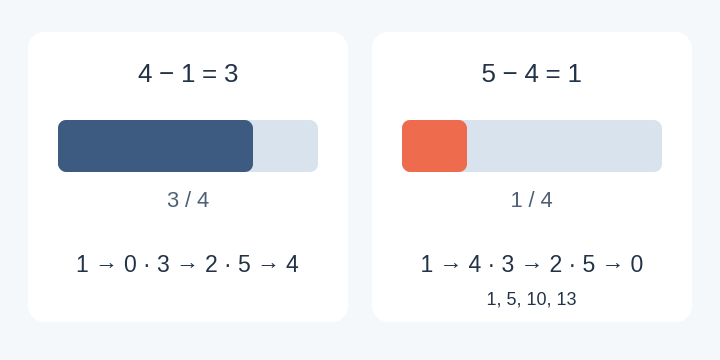
Each agreement response is numbered from one to five. Direct-coded statements receive response minus one, producing zero to four points. Statements 1, 5, 10 and 13 are reverse-coded: they receive five minus response. This simply preserves the directional coding used by the custom questionnaire. It does not validate the statements or turn the total into a clinical measure.
Agreement adds points on eleven direct-coded statements; disagreement adds points on four reverse-coded statements. The scale runs from 0, the minimum coded points, to 100, the maximum. All-neutral answers give 50. Read each original answer alongside its coding; these arithmetic anchors do not describe population norms.
The index is 100 × total coded points ÷ (4 × number of scored responses). The calculation retains full precision and the displayed index rounds to one decimal. With all fifteen neutral responses, each contributes two points: 15 × 2 = 30, the maximum is 15 × 4 = 60, and 100 × 30 ÷ 60 = 50. That is a midpoint in the arithmetic, not a clinical classification.
| Control response pattern | Coded points / maximum | Displayed index |
|---|---|---|
| Maximum: response 1 for reversed statements, 5 for the others | 60 / 60 | 100 |
| Minimum: response 5 for reversed statements, 1 for the others | 0 / 60 | 0 |
| Every response neutral | 30 / 60 | 50 |
| Every response strongly agree | 44 / 60 | 73.3 |
| First statement not applicable, others neutral | 28 / 56 | 50 |
| Every statement not applicable | 0 / 0 | No index |
All strongly agree is not the maximum because the four reverse-coded statements contribute zero. If every statement is not applicable, there is no scored denominator and no index is calculated. The final summary requires all statements to have an answer or not-applicable choice. An unanswered item remains unfinished rather than becoming a hidden zero.
Keep lived experience larger than the score
The NHS information on signs in adults discusses masking: adaptations can make outward signs less visible and social interaction exhausting. That is one reason a short answer cannot describe every setting. The questionnaire does not measure masking or calculate a correction for it. A note can describe a difference between outward appearance and internal effort without converting that difference into extra points.
The NIMH adult assessment information explains that evaluation can include current experiences and early developmental history. This questionnaire does not perform that assessment. Concerns, strengths and support needs deserve discussion regardless of a high or low response index. A qualified healthcare professional can consider information and alternatives absent from these fifteen statements.
Read the score-limit guide if the number feels more definitive than it should. The context-note guide helps turn a broad answer into a specific description. Neither guide supplies a diagnosis, treatment plan or test threshold.
Choose what to save and what to export
The tool makes no network requests and does not save automatically. Save on this device stores the current reflection locally, including answers, marks and notes. Resume restores that record. Clear saved reflection removes this questionnaire’s saved record while leaving your current unsaved work intact. Starting over separately asks for confirmation before replacing current answers and notes. On a shared browser, saved personal material may be accessible to others.
Copy, download and print use the report you select. Individual answers and notes are excluded by default; tick the relevant options only when you want them included. The general-information scope and arithmetic explanation stay attached to every report. A blocked clipboard leaves selectable text for manual copying. The reflection area is masked from page replay analytics, but deliberate exports go to the destination you choose. For a conversation about assessment, the preparation guide keeps examples and questions in view.
Questions about this reflection
Can this diagnose autism?
No. These custom statements are not a validated screener and no score confirms or rules out autism.
Is this the AQ or RAADS-R?
No. It is a fifteen-statement reflection questionnaire with transparent custom coding, not either published instrument.
Does a higher index mean more severe autism?
No. The index summarizes coded responses and has no clinical severity scale, probability or diagnostic threshold.
What if I cannot judge a statement?
Choose Not applicable. It counts as completed but is excluded from the scored denominator; neutral is included.
Will my answers be saved automatically?
No. Save is an explicit local action. Resume and Clear manage the saved record on this browser.
Can I export only the topic summary?
Yes. Individual answers and notes are excluded by default. Select them explicitly if you want them in a copied, downloaded or printed report.
Read beyond the response index
 What an online autism test score can and cannot tell youA precise decimal can still be custom arithmetic. Read the questionnaire identity, denominator and limits.5-minute read
 Autism-related experiences: write useful context notesA specific situation can say more than a score. Separate the event, your experience and the question you want to discuss.5-minute read
 Preparing for an adult autism assessment conversationStart with the question you want answered. Bring examples and clear limits rather than a score without context.5-minute read
Updated