Preparing for an adult autism assessment conversation

You may want to understand a longstanding pattern, ask about support or clarify whether an assessment is appropriate. Those are different goals. I would write the question I want answered before printing a questionnaire score, because a custom index cannot tell a professional what matters most to you.
State what you hope the conversation will clarify
A reflection questionnaire can help organize experiences, but it cannot decide whether you are autistic or whether a particular referral is appropriate. You might want to ask about communication difficulties, sensory experiences, routines, exhaustion or the practical effect of a longstanding pattern. Describe the concern without treating a response index as its cause or a diagnosis.
The NIMH adult assessment information describes evaluation that can consider current experiences and early developmental history. That broader process is different from answering fifteen statements online. A professional can ask questions, consider context and assess information absent from this questionnaire. No high or low score replaces that conversation.
Referral routes and available services vary by location and provider. Do not assume that a webpage can promise access, eligibility, cost or a particular outcome. If you want help understanding the local route, ask a qualified healthcare professional or the relevant service what its process involves. This guide supplies general preparation information, not medical advice or a recommendation for a particular service.
Gather examples without forcing them into a label
Write a few specific situations rather than a long list of traits you think you ought to have. Include the setting, what happened, how it affected you and what remains unclear. A description of a repeated difficulty and an exception can both be useful. For example, note whether instructions were easier in writing than when several people spoke at once, without claiming that the difference proves autism.
The five topics in Autism Test can organize notes, but they are not a required clinical checklist. You may have relevant experiences outside those groups. Likewise, a preference for factual reading or noticing a pattern is not by itself a diagnosis. The professional conversation can address information that the statements do not ask about, including other possible explanations.
| Material you might organize | What to write | What not to infer |
|---|---|---|
| Current examples | Situation, experience and practical effect | One event proves a diagnosis |
| Longstanding patterns | What you remember and what is uncertain | A perfect memory is required |
| Questions about support | The task or setting you want help discussing | A questionnaire determines eligibility |
| Reflection record | Actual answers, denominator and limitations | A custom index is a clinical threshold |
| Your goal | What you hope to understand | A particular outcome is guaranteed |
Keep uncertainty visible. If you do not remember an early experience, say that rather than inventing a history that matches a question. If a note comes from someone else’s recollection, distinguish that from your own memory. The tool cannot verify either source or determine what an assessor will need in your circumstances.
Ask how developmental history is considered
Adult assessment may involve questions about earlier life as well as current experiences. It may also include a conversation with family or caregivers where appropriate. You can ask the service how it approaches history and what happens when records or an informant are unavailable. This questionnaire does not require another person’s involvement and does not decide whether an assessment can proceed without it.
Do not contact or involve someone merely because an online questionnaire suggests you should. Consider what you want to discuss with the professional first, especially where family relationships or personal information are sensitive. An assessment service can explain its own process and consent arrangements. The preparation task is to ask clear questions, not to arrange a clinical investigation yourself.
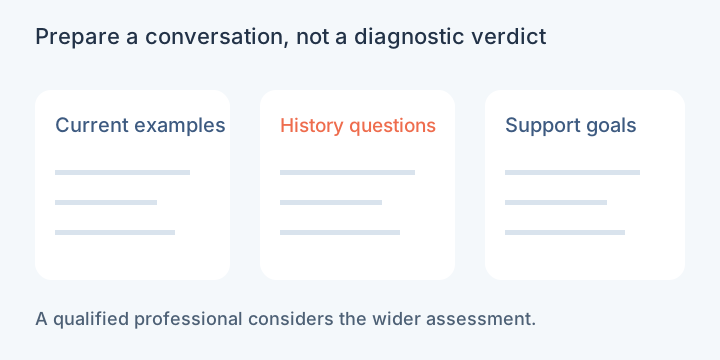
A longstanding pattern can be described without assigning a cause. You might record that an experience occurs across settings or is limited to particular circumstances. The distinction may help a conversation, but the reflection index does not incorporate duration, setting or developmental history into its arithmetic. It cannot use those notes to correct a result or calculate a diagnostic probability.
Bring the parts of the record that serve your purpose
The default exported report includes the response index, topic summaries, counts and explicit limits. Individual answers and notes are optional. Select only what you want the destination to receive. A topic summary alone can omit important context; a few relevant notes may communicate your question better than a full answer list. You decide what to include rather than accepting an automatically shared personal profile.
The record should retain the statement that this is a custom adult reflection, not the AQ, RAADS-R or a validated screener. Its response index has no clinical threshold, percentile or severity interpretation. A professional may choose different questions or tools, and a different instrument’s scoring cannot be substituted for this one. Ask about the meaning and purpose of any instrument used in the actual assessment.
You can also attend a conversation without a completed questionnaire. Concern or a need for support does not depend on finishing these statements or obtaining a particular index. A lower number does not dismiss a practical difficulty; a higher one does not establish what caused it. The score-limit guide explains those distinctions in detail.
Write a short set of questions before the appointment
- What information would help you understand these experiences?
- Would a specialist adult assessment be appropriate to discuss?
- How does the local process consider current examples and earlier history?
- What support or information can be discussed while questions remain open?
- What does the next step involve, and whom should I contact?
These are conversation prompts, not a demand for a particular diagnosis or a promise that a service will take a specific action. Leave room for the professional to ask different questions and explain the options. If you want to record the discussion afterward, separate what was said, what was agreed and what remains uncertain instead of treating a general explanation as a final assessment outcome.
Return to the context-note guide for a concise way to describe a situation. The reflection questionnaire can keep those descriptions alongside your choices without uploading them. Save is optional on this browser, and exports go to the destination you deliberately select. This guide is general information and does not diagnose, treat or replace care from a qualified healthcare professional.
FAQ
Do I need a high index to discuss concerns?
No. Concerns and practical support questions deserve discussion regardless of this custom response index.
Will this record guarantee a referral or diagnosis?
No. Local processes and individual assessment differ; the questionnaire cannot determine eligibility or outcomes.
Must I include every answer in the report?
No. Individual answers and context notes are optional exports. Choose the material you want to share.