What an online autism test score can and cannot tell you

A result of 73.3 can look authoritative even when it is only 44 coded points divided by a possible 60. I read the arithmetic and the questionnaire’s identity before interpreting that number. Without that context, a custom reflection index can be mistaken for a probability, percentile or diagnosis that it was never designed to provide.
Identify the questionnaire before reading its score
Autism Test contains fifteen custom reflection statements grouped into five topics. It is not the AQ or RAADS-R and is not presented as a validated screening instrument. The question wording, response choices and coding belong to this specific reflection. A threshold from a different named questionnaire cannot be imported just because both tools concern autism-related experiences.
That distinction matters even when a page uses familiar words such as spectrum, traits or screening. A title does not establish validation. The number of statements, their wording, the response scale, scoring rules and intended population all affect what a result means. Changing one of those elements and retaining another questionnaire’s interpretation can produce a misleading impression of scientific continuity.
I would not read a custom index as a clinical answer, even with a disclaimer underneath it. The visible result itself must remain honest: no categories of few or many signs, no diagnostic cutoff and no invented bell curve. Here the summary names its scored denominator, shows the topic arithmetic and lets you inspect every response. Those features make the calculation reviewable; they do not validate it clinically.
Inspect a result that looks precise
For direct-coded statements, strongly disagree is response one and receives 1 − 1 = 0 points. Strongly agree is response five and receives 5 − 1 = 4 points. Four statements are reverse-coded: their points are 5 minus response. The reverse-coded item numbers are 1, 5, 10 and 13. Each scored item therefore contributes zero to four points.
With all fifteen responses strongly agree, eleven direct-coded items contribute 11 × 4 = 44 points and four reversed items contribute zero. The maximum for fifteen scored responses is 15 × 4 = 60. The index is 100 × 44 ÷ 60 = 73.333333…, displayed as 73.3. That decimal tells you how the total was scaled and rounded. It does not mean a 73.3% chance of autism.
| Number type | What it would require | What this tool provides |
|---|---|---|
| Response index | The stated coding and denominator | Yes: inspectable custom arithmetic |
| Population percentile | An identified comparison dataset | No |
| Diagnostic probability | A justified predictive model and context | No |
| Clinical severity | An appropriate clinical assessment | No |
| Screening threshold | A validated instrument and intended use | No |
All neutral responses produce 30 points out of 60 and an index of 50. That is not a border between two clinical groups. The directional maximum produces 100 and the minimum produces zero; neither confirms nor excludes a diagnosis. These control patterns are useful for checking the code, not for dividing people into autistic and non-autistic categories.
Read the denominator and missing responses
Not applicable is deliberately different from neutral. Neutral means the middle agreement choice and contributes two points. Not applicable contributes no points and is excluded from the scored maximum. It still completes the statement for navigation. An unanswered item does neither and prevents the final summary from opening, so an incomplete reflection cannot quietly appear complete.
If the first statement is not applicable and the remaining fourteen are neutral, the total is 14 × 2 = 28 out of 14 × 4 = 56. The index remains 100 × 28 ÷ 56 = 50. The first topic has two scored responses and its own maximum becomes eight. Counts are shown beside the index because the same scaled number can summarize different amounts of information.
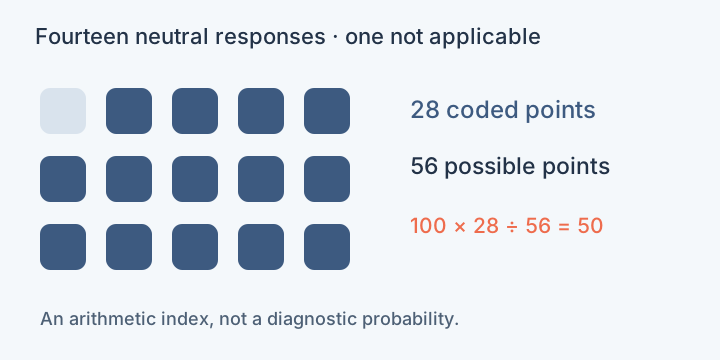
When every statement is not applicable, the scored maximum is zero. Dividing by zero would not produce a meaningful index, so the interface shows a dash and explains that no scored responses exist. You can still inspect choices and notes. Treating that situation as a score of zero would wrongly turn missing applicability into the minimum directional pattern.
A topic label does not make a measured scale
The five topics organize three statements each. They are practical groupings for a reflection questionnaire, not independently validated clinical domains. The interests-and-perspective group, for example, includes imagining another viewpoint, strong interests and a preference for factual information. Those are different experiences; combining their coding cannot diagnose an imagination deficit or describe the whole of a person’s communication.
A high topic index tells you that the coded responses add up to a larger share of that topic’s scored maximum. It does not tell you whether the experience is distressing, useful, longstanding, situation-specific or explained by another circumstance. A note about what happened supplies some of the context that the number omits. The context-note guide offers a way to keep that description concrete.
Decide what question the result leaves open
The useful next question is not whether an index passes a threshold. Ask which statements were difficult to answer, what examples came to mind and what you want to understand or discuss. An online reflection cannot evaluate early development, everyday functioning, overlapping explanations or personal support needs in the way an adult assessment can. The NIMH information describes adult evaluation as a broader process.
Concerns deserve discussion regardless of the index. A lower result does not dismiss a difficult experience, and a higher result does not establish its cause. If you want professional input, bring specific examples and questions to a qualified healthcare professional. This article is general information, not a diagnosis, medical advice or a substitute for assessment.
Return to the reflection questionnaire to review each actual answer instead of repeatedly retaking it to seek a preferred number. You can revise an answer when your understanding changes; the updated result is still a summary of that custom response set. Keep the scope, coding and denominator with any exported record so a bare number is not separated from its limits.
FAQ
Is 50 a clinical cutoff?
No. In this tool it is the arithmetic midpoint for all-neutral responses, with no diagnostic interpretation.
Can I compare this index with an AQ score?
No. Different statements, response scales and coding do not create interchangeable scores.
Why do not-applicable answers change the denominator?
They are not scored. The tool separately displays the number of scored and not-applicable responses.