Autism-related experiences: write useful context notes

“Changes upset me” is a broad answer. “An unannounced room change made it hard to follow the meeting, while a written plan helped” is a specific example. I prefer the second description because it separates the event, your experience and the context without trying to turn one situation into a diagnosis.
Write the situation before the interpretation
An optional context note belongs to one of the five reflection topics and is shared across that topic’s three statements. You do not need a clinical vocabulary to use it. Describe where you were, what the task involved and what you noticed. A familiar conversation, a crowded social event and a written exchange can feel different even when the same statement appears relevant to all three.
Keep observation and interpretation distinct. “I asked for the instructions again” describes an action. “That proves autism” is a conclusion the questionnaire cannot support. If you are unsure why something happened, say so. A note can be useful while leaving the explanation open; it does not have to fit a particular label to deserve attention.
You can also record what was comfortable or useful. Strong interest in a topic, noticing a small detail or enjoying predictable steps does not automatically describe a problem. What matters for a conversation is the effect in your setting and what you want to understand. A deficit-only description can omit strengths and miss the practical question you meant to ask.
Use a short structure that keeps the context
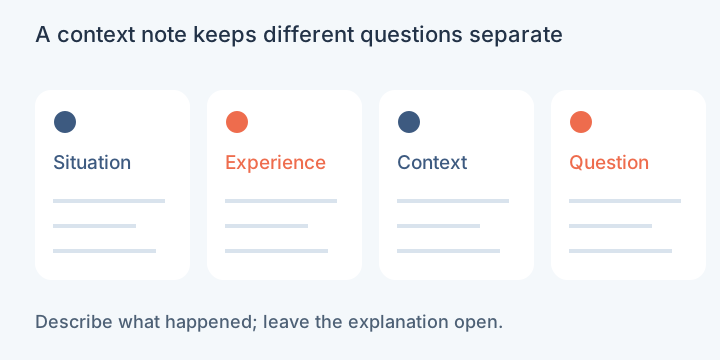
| Part of the note | Illustrative wording | What it keeps separate |
|---|---|---|
| Situation | The instructions changed during the group task. | The event |
| Experience | I needed time to work out the new order. | Your response |
| Context | Written instructions were easier than several spoken changes. | The communication format |
| Effect | I missed part of the next discussion. | A practical consequence |
| Question | Could clearer advance information help in that setting? | What you want to discuss |
The example is hypothetical. It shows how a note can explain a response without making a clinical claim. You may have a different pattern, a different effect or no concern at all. The point is not to produce the “right” example for assessment; it is to describe your own experience accurately, including uncertainty and exceptions.
If a statement fits one context but not another, record that difference. Perhaps small talk is easy with familiar people but difficult when several people speak at once. Perhaps switching tasks is manageable with a warning but harder when it interrupts an absorbing activity. These descriptions explain why a single agreement choice may feel incomplete. They do not add hidden points to the index.
Include effort that an observer might not see
Outward behavior and internal effort are not always the same. The NHS discussion of adult signs explains that masking can make signs less noticeable and interaction exhausting. The questionnaire does not measure masking. It simply gives you space to describe effort or recovery that a short response would otherwise leave out.
Avoid deciding from one example that you must be masking. You can describe what you did, how it felt and what you noticed afterward without asserting a cause. If you copied a conversational pattern, rehearsed what to say or needed quiet afterward, those observations can be written in ordinary language. A qualified professional can consider them within a broader history if you seek an assessment.
The same care applies to sensory notes. Name the setting and the input rather than making a universal statement such as “I cannot tolerate noise.” A busy room, an unexpected sound and an ongoing background hum are not identical experiences. You can record that something was noticeable without claiming it caused a clinical symptom or that one adjustment will work in every situation.
Let uncertainty remain a real answer
Neutral and not applicable serve different purposes. Neutral is the middle agreement response and is scored. Not applicable or cannot judge is excluded from the scored denominator. Use the latter when you cannot give a meaningful agreement answer, rather than filling every item with a guess to obtain a complete-looking number. A note can explain why the item was difficult to judge.
Mark a statement for review when you want to return to it. The map preserves your other choices, and selecting an answer does not move you forward automatically. You can take time to read the wording and revisit a response after writing a note. The final summary requires all fifteen statements to have a response or a not-applicable choice; it does not require every statement to be scored.
There is no requirement to repeat the reflection until your answers look consistent with a desired conclusion. Different situations can produce different answers, and changing an answer changes this particular arithmetic record. The index does not measure improvement or deterioration. The score-limit guide explains why a topic chart cannot serve as a clinical severity scale.
Choose how much personal detail to keep
The note fields accept up to 2,000 characters per topic. Short concrete examples are usually easier to review than a long account with many names and unrelated events. Avoid identifying details you would not want stored on a shared browser. The tool does not save automatically; Save creates a local record, and Clear removes that saved record separately from the current unsaved reflection.
The reflection area is masked from page replay analytics, and the tool makes no network requests. Deliberate exports are different: a copied report goes to your clipboard, a downloaded file goes to your device, and printing goes to your selected printer or PDF destination. Notes are excluded from reports by default. Tick Include context notes only when you want them to travel with the report.
You can bring a selected note to a discussion without exporting every answer. The assessment-conversation guide helps organize questions while leaving clinical decisions to the appropriate professional. This is general information, not a diagnosis or medical advice. Your descriptions are a way to communicate what matters to you, not a test you must pass.
FAQ
Must I use clinical terminology?
No. Plain descriptions of a situation, your experience and what you want to discuss are appropriate.
Does a context note change my score?
No. Notes are separate from the response arithmetic and add no hidden points.
Are notes included in exports automatically?
No. Include context notes is unchecked by default; select it only when you want notes in the report.